Showing posts with label civil liberties. Show all posts

Tuesday, 14 February 2006

Endorse an End to Torture

From the National Religious Campaign Against Torture:
Torture violates the basic dignity of the human person that all religions hold dear. It degrades everyone involved --policy-makers, perpetrators and victims. It contradicts our nation's most cherished ideals. Any policies that permit torture and inhumane treatment are shocking and morally intolerable. ...
It continues in simple and direct language, imploring our leaders to remove all ambiguity about our commitment to eschew torture or the rendition of prisoners to states where they may be tortured. It is sponsored by a coalition of liberal and conservative theologians and others from many faith traditions.

Please follow the link, read the statement, and endorse it. There will be an opportunity to make an optional donation if you would like.

Thank you to Mary at Pacific Views for calling my attention to this important cause.

Monday, 26 December 2005

Government Spying

Some may think me remiss for not doing my part to pile on in attacking the Bush Administration for its illegal spying on American citizens and residents without receiving proper authorization. Well, make no mistake: I strongly disapprove. I largely agree with pundits as disparate as conservative George Will and liberal Markos Moulitsas here and here, in believing that this administration overstepped its bounds, and should not expect another free pass based on another plea of "Trust us."

That said, this is not the issue that most animates me.

I did earlier point to this excellent article by Hilzoy at the Washington Monthly who credibly makes the case that this revelation more than many others out of this administration meets a very high bar which he thinks necessary before seriously discussing impeachment. I am pleased that this is a story which has given pause to conservatives and libertarians, often defenders of the President's policies, creating momentum on Capitol Hill for Congressional hearings into the President's actions.

So why is this not front and center on Choosing Hope?

Perhaps it is because I'm so public in my views, that I'm more amused than outraged that my communications could be mined for their possible threat to the national security. I had better be careful, and I should be outraged, but there are plenty of others carrying the torch on this one, and I trust that they will persevere in their relentless call for the reining in of expanded executive power.

Perhaps this is how I might be listened in on. ;-)

But if you want my words, here is part of what I wrote in response to one conservative's ambivalent reaction to this story:
All indications are that FISA is very liberal in granting warrants, and THE PROCEDURES DO NOT REQUIRE ANY DELAY IN STARTING THE SURVEILLANCE and FISA’S DELIBERATIONS REMAIN SECRET. Following the law here would not have hampered any necessary surveillance to protect our security.

The only explanations I see for Bush going around the secret security court are either that he was initiating surveillance that he knew was questionable, or that he simply wanted to extend the power of the Presidency and flout the law.

I’m all for spying on the truly bad guys to keep us safe, but we had a system that allowed the executive branch to do just without tipping our hand, while remaining accountable for its actions through an independent secret court. Judge James Robertson, assigned to the court by Justice Rehnquist has resigned in reaction to this news, expressing through friends “deep concern that the NSA surveillance program, which was personally authorized by President Bush in 2002, was legally questionable and may have tainted the court’s work.”
In spite of relentless attempts to spin this and other stories for temporary bumps in the polls, this is yet another instance of further self-inflicted erosion to the core of support this administration was once able to count on. And yeah, I'm happy about that.

Thursday, 17 November 2005

Insisting on a Higher Standard

White phosphorus should not be used as a weapon - period.

Regular readers know that I have a high tolerance for a diversity of opinion, while espousing my usually liberal but rarely strident views. I have a very low tolerance, however, for sanctioning the mistreatment of others, regardless of who they might be.

When Bush nominated the architect of a policy which sanctioned inhumane interrogation techniques to be the chief law enforcement official of the land, I cried foul. When Cheney seeks exceptions to a universal no torture policy, that's not just unwise, it is immoral.

War is an awful, awful business, and it is with good reason that one of just war theory's precepts is that it be used as a last resort. Bush's decision to go to war with Iraq looked more like one based on a last opportunity, not a last resort, and hence I unambiguously opposed it, and marched against it, before we went in. Once in a war, civilian casualties are all but unavoidable. I don't deny that compared to many previous wars, a great deal of effort was placed on minimizing civilian casualties in this one. As the war lengthened, it was inevitable that more lapses in this effort would occur, and it seems likely that one of the most scientifically credible studies which was under-reported in the mainstream American media estimated 100,000 Iraqi deaths, mostly civilian, one year ago. It matters not that the opportunity to go to war may have been lost, with the U.N. inspections process still underway and making progress, it was not a last resort. Period.

So when an Italian source reported about one week ago that the incendiary white phosphorus had been used against a civilian population in Falluja, I was concerned. I did not jump on the story which was being roundly debunked in much of the right leaning press and blogosphere, as I am disinclined to lend credence to a single source without corroboration. Yesterday's admission by the Pentagon that the chemical, colloquially known as 'Willie Pete', had been used as a weapon in Falluja, represented a change in their story from their claim of a week ago:
The US initially denied reports it had used white phosphorus as a weapon in Falluja in November 2004, saying it had been used only for illumination and laying smokescreens. However, the Pentagon has now confirmed the substance was used as an "incendiary weapon" during the assault.
(read the whole thing)

Though they continue to deny that it was used against civilians, and argue that its deployment was not illegal, is it any wonder that such claims have lost credibility with much of the world now that their story has changed?

I will not apologize for my insistence that my nation be held to a higher standard when it comes to the treatment of our enemies, suspected enemies, or those who may be caught in the crossfire.

When Senator Bond was debating Senator Durbin last week in defending his vote against McCain's amendment prohibiting torture and inhumane treatment, he fell back on the argument that the rules would prohibit treatment which is typical for our own recruits at boot camp. Well maybe we should look at our treatment of our own forces, but we should not give carte blanche to unknown agents to interrogate unknown prisoners at unknown locations outside the constraints of international law. Insisting on a higher standard is what America should be all about.

Sunday, 31 July 2005

Liberty, Security, Privacy, & Social Responsibility

Some beliefs have their roots in a deeply seated conviction, while others are based on practical considerations. I generally think of the former as trumping the latter, but really it depends on what is at stake, and how compelling the conviction or practical consideration is.

Sometimes something which began from a practical consideration becomes such an article of faith that we start believing that it is tied to a deeply held moral conviction even though it is not.

Looking at my title, I believe that Security and Privacy are practical values, while Liberty and Social Responsibility are values of conviction. I'm a member of the ACLU, and am happy to pay my annual dues, but sometimes I do believe that they tend to make articles of faith out of principles which stem more from practical considerations than deeply held convictions. Putting a lid on government snooping is one such instance.

Now in the current political climate, I am happy that the ACLU is acting as a watchdog on our government, because that function is sorely needed. There are sufficient troubling stories about surveillance which is based on ideological position rather than on keeping tabs on true menaces, that I look to the ACLU as a protector in that regard.

But from a utopian perspective, government having information about its private citizens is not an a priori evil. Open information, in fact, should be seen as a good thing. We can make the best decisions and be accountable to the highest standards when transparency is high - in government, in corporations, and in our personal lives. I've not yet read David Brin's The Transparent Society, but am favorably disposed to the ideas which I understand he espouses there. Unfortunately we live in a world where power is inequitably distributed and unscrupulous institutions are all too willing to use information about others for nefarious ends.

So in the short term, practical considerations sometimes must trump ideals, if that lessens the ability of the powerful to exploit the vulnerable.

The national identity card, which many of my friends would decry as an outrageous infringement on their freedom, is not dangerous because it is at odds with some inherent truth, but because of the practical possibility that it could be misused by a government more intent on silencing its enemies than protecting its citizens. The time for a national identity card is not now, but only after the ability to misuse it has been limited convincingly by laws with teeth, and the expectation that they be followed scrupulously.

DNA fingerprinting has proved to be an invaluable tool in criminology, superceding ordinary fingerprinting as the gold standard for identification. In an ideal society, our government would be so fully trustworthy, that it would be plainly obvious to anyone that every infant or immigrant would have their DNA recorded in a national database. True criminals would be hampered, missing persons could be more easily found, medical matches would be quickly found - though always with the right to refuse participation without identification to third parties. Strict laws and societal expectations would circumscribe the use of the database for just these sorts of cases, and never for commercial exploitation, oppression, or blackmail.

Clearly we're not there yet. Perhaps we never will be. But my point is that privacy in and of itself is not such an inherent value that it should be protected above all else. I recently discovered Jack Grant's Random Fate where he writes
The struggle is between liberty and safety, as it always has been, but now the struggle is waged in a society and culture that has valued the freedom of the individual at the expense of a larger social responsibility that was so ingrained in the culture of the founders that it literally went without saying in most of their writings.
in making his own case that the ACLU overreached in challenging the constitutionality of random New York subway searches. Though I found myself in this particular case more inclined to agree with some of his commenters who suggested that the searches were far likelier to result in abuse than to quell an actual attack, that is a practical judgment, and Jack's point stands insofar as it will not ALWAYS be correct to limit every intrusion. There is a balance to be struck, and we err in thinking that privacy is sacrosanct in every instance.

Saturday, 18 September 2004

Upholding Principles of Democracy

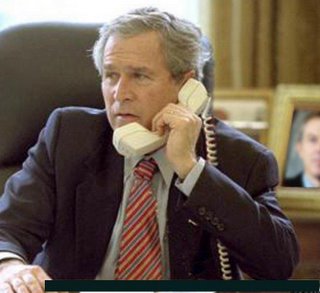
Our President should listen to his own words!

"As governments fight the enemies of democracy, they must uphold the principles of democracy."
-President George W. Bush, appropriately expressing concern over the recent efforts by Russian President Vladimir Putin to centralize power.

I suspect Putin found the recent tragedy at Beslan to be a convenient excuse to use people's fear of terrorism as a justification for imposing tyranny.

They do not quite rank up there with Putin's call to end popular elections of regional governors, but the freedoms removed by the USA PATRIOT Act and subsequent actions by our government, presumably in the name of protecting freedom, could easily evoke the exact same words from its critics.

Further it seems that using a tragic act of terror, 9/11, as an excuse for all manner of actions from government secrecy to preemptive war is the modus operandi of the Bush administration. [End of Post]

Friday, 20 August 2004

"The Country Will Be Lost!"

Every election cycle there are those who predict doom and gloom should the country elect the "wrong" President. Never in my lifetime though, have so many been so earnest in their belief that the "wrong" result in November bodes terrible ill for our nation and our world. It may be that the extent of the concern is overblown, but I am sure from my conversations with people on both sides of the fence that the concern is genuine and heartfelt.

Though I attempt to observe American politics phenomenologically, I am also a participant and actor and feeler in the political process. As a feeler, I understand at a personal level the urgency driven by the fear of what a Republican victory could mean. Visions of an encroaching Big Brother, further sell-out to big corporate interests, and megalomaniacal plans for world domination laid out by the blueprint of the Project for a New American Century, drive me and others to a concern that we may pass a point of no return in which dissenting voices are silenced and the great American Experiment will be lost. For my own part, I see that as a plausible concern, but by no means a foregone conclusion should Bush win reelection. Regardless of November's result, I will not give up hope for a better world.

The concerns of the right are just as vivid, whether they see a moral collapse or an economic one, or an unwillingness to stand up militarily if necessary to very real threats from outside our borders. The craziness of the world today coupled with the potential for technological destruction can feed a palpable fear regardless of one's point of view.

So the concerns are real and exist of their own accord, but there is political advantage to be gained by stoking those fears, especially when there is a sense that one is behind. Whether this is seen as shining a light on the truth or demagoguery is largely a matter of perspective. When MoveOn.org ran their ad campaign at the end of last year, and solicited our contributions to pay for them, those of us who participated felt we were exposing truths about Bush & Co. that the mainstream media was too timid (or too owned) to report on. Now that Kerry appears to have gained a slight upper hand, it is the Bush campaign which is selling the idea that Kerry isn't willing to stand up to the forces of terrorism, and would make military decisions based on political expediency. Of course it is very convenient for the Bush campaign that as a Senator, Kerry is constrained to an up/down choice on any bill. If, for instance, the Democratic rider, which would have funded the $87 billion military appropriations bill, had not failed due to the threat of a presidential veto, then indeed Kerry would have voted for the appropriations.

In evaluating the political claims of a campaign or its supporters, it's important to see them in context, seek opposing viewpoints, and especially to seek the views of those without a vested interest in the cause. FactCheck is a website I recommend which calls out the deceptions of both campaigns. It's also wise to avoid guilt or innocence by association. If a claim is debunked, it does not mean that all similar claims are untrue, nor does it mean that causes or candidates supported by those who made the faulty claim are culpable. In looking at the current Presidential campaign, I see politicians, all of whom play politics with facts, and I wouldn't expect it to be any other way. I also tend to dismiss claims that suggest that one or the other candidate is primarily inspired by an evil plan for the future of our country. They are after all human beings with faults and merits like anyone else. From my perspective, however, the preponderance of evidence points to the current administration being guided by precepts and advisors whose primary agendas are at variance with many of the values I hold closest. While I may not be especially convinced of the forthrightness or convictions of Kerry, his campaign's deceptions strike me as fundamentally and consistently less egregious than those the President's campaign is willing to stoop to, such as those used to justify the war with Iraq. We would be fools to expect to have saints as candidates for President in this age of media sound bites and influence peddling, but I think we can expect better than the current leadership. I have come to my views earnestly by examining evidence, relying on my own values, and on my gut, but that doesn't preclude me from respecting those who have reached differing conclusions.

Many of us tend to move in circles which reinforce our own predilections. This has a tendency to insulate us from reasoned opinions which run counter to our own. It makes it all too easy to generalize about those who disagree with us, without thinking of them as independent thinkers who may actually share many of our own values. My own circumstances tend to create this insulation for me, and it takes effort on my part to "deinsulate" myself. Joining WatchBlog as an editor was one such effort, but online interaction is not enough--I need personal contact as well to nurture respect for a diversity of opinion. I have joined a conversation cafe locally, only to find that its membership is currently seriously lacking in conservative opinions. Their rules and principles are sound, however, and I would encourage others to seek this type of interaction. A recent cross-country trip to visit in-laws put me in touch with intelligent thinkers of various political opinions. I know that it is healthy and energizing for me to engage in conversations with serious Republicans and Libertarians as well as fellow Democrats. It may be exhausting to do so all the time, but insulation is surely unhealthy.

In conclusion, I certainly can't claim to know whether Bush's reelection would truly threaten American democracy on a long term basis--I certainly hope not, and I'm very confident that the right will remain strong as an opposing force even if Kerry wins and the Democrats take both houses of Congress. But I would advise my readers, when you feel hysteria beginning to overtake you, take a deep breath, remain calm, and be willing to speak your truth to many audiences, and be willing to truly listen to those of differing opinions who argue with reason and in good faith.